Consistent programmes. Uniform assessment. Without surveillance.
The consistency of a programme is decided before the first class: each subject must serve the qualification's skills blocks, each piece of material must follow its syllabus, each exam must assess what was taught. Then the same submission must be assessed against the same standards, whichever teacher marks it. CORRAICT equips both.
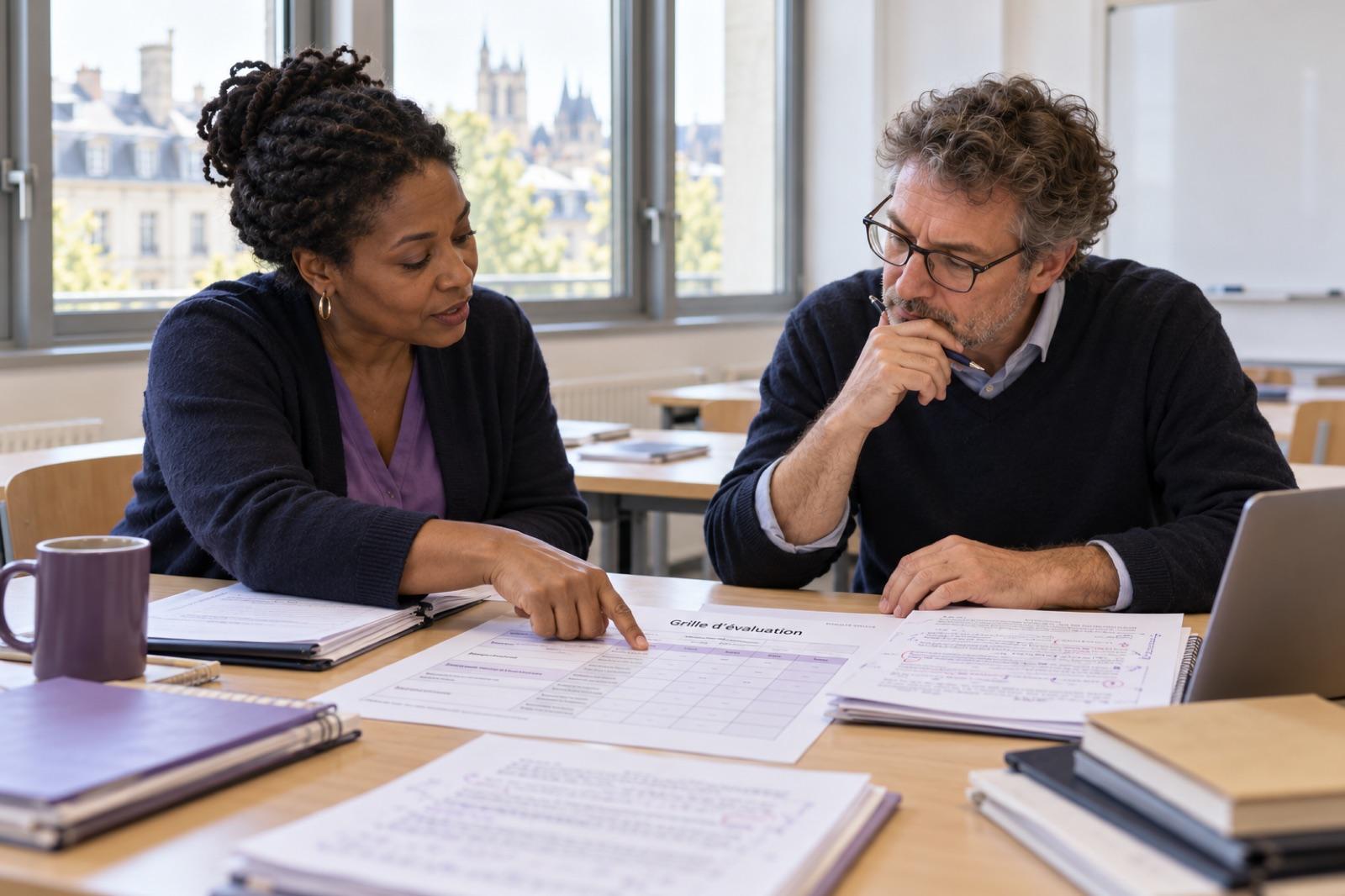
A programme that holds together, from the RNCP qualification to the exam.
Every subject knows which blocks it serves
A programme's subjects are proposed from the selected skills blocks, and each one keeps that link. A block that no subject covers shows up before approval, not at audit time.
A shared base of syllabi and material
Syllabi and course material are drafted from each subject's record, reviewed and published by your team. All teachers start from the same base, in the institution's colours.
Exams built on the blocks
A certification case study is designed for the blocks you choose, and its outline shows which subjects each part draws on.
What actually brings two markings closer together.
None of them involve comparing teachers with one another.
The same marking scheme, literally
An exercise is shared across the institution with its marking scheme and expected answers. Two teachers starting from the same exercise mark against the same scheme — not against two interpretations of the same wording. Each can make their own copy and adapt it, without altering the original.
The same framework, from the outset
When a subject is linked to the RNCP qualification, the targeted skills blocks are passed to the exercise generator. Alignment happens at the point of designing the exam — where it costs the least — not in a standardisation meeting after the fact.
Marking that can be reviewed
Each point is tied to a criterion and supported by the extract from the submission that justifies it. Two divergent markings can then be compared on a specific criterion rather than on an overall impression — which is what makes a standardisation meeting useful rather than merely polite.
What CORRAICT does not do, and will not do: measure the grading gap between two teachers, produce a ranking, or flag who marks more harshly. That indicator does not exist in the product — not through oversight, but because it would turn a working tool into a monitoring tool, and your teams would stop using it.
Enough to manage. Not enough to monitor.
The same limit is stated on the page your teachers read — so that neither party has to take the other's word for it.
What you have access to
- The institution's assessments, their submissions and their markings, available for review.
- The history of an assessment: who created it, who approved each grade, and on what date.
- The exports that serve as audit evidence: grades for a session, the submission file, teaching notes.
- The platform access log and activity for ongoing assessments.
What does not exist
- No comparison of severity, speed, or volume between teachers.
- No productivity indicators, whether individual or aggregated.
- A teacher's design work — what they generate when preparing their exams — remains their own.
- Their support requests too: these belong only to their author.
What works, according to those who have done it.
A teaching team does not adopt a marking tool because of a circular.
One volunteer, one class
A teacher who has already marked their assessment, and who compares. They know the grades: it is the only test they will trust.
They show their colleagues
Not you. A teacher who explains to a colleague that their marking scheme was followed carries more weight than a presentation at a pedagogical council.
You share the exercises
That is when consistency arrives — not through instruction, but because the same exercise and the same marking scheme are being shared.